CVPR 2026 Workshop
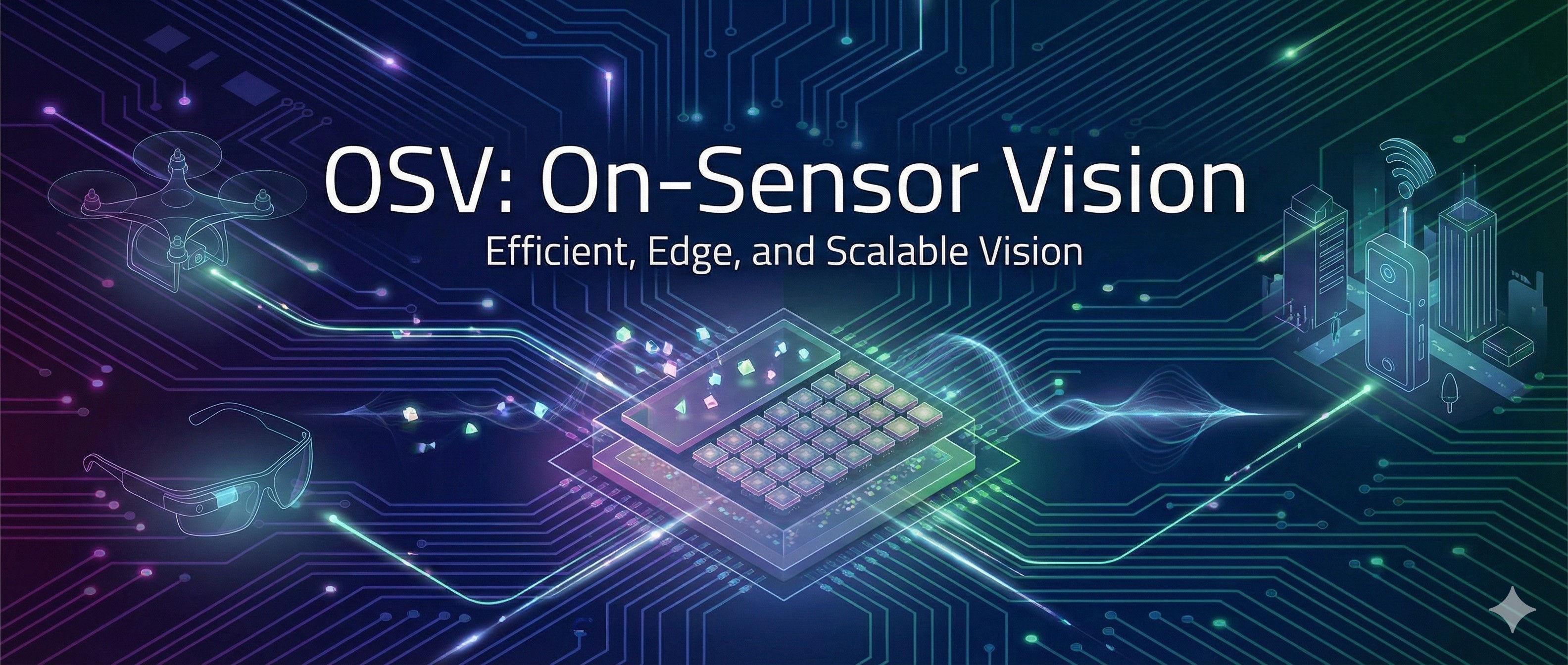
Computer Vision is moving to the edge - into drones, robots, IoT devices, AR/VR headsets and autonomous systems. These applications demand processing that is fast, energy-efficient, and privacy-preserving. On-sensor vision addresses these challenges by unifying sensing and computation on a single chip, producing information-rich outputs instead of raw pixel data.
In modern computing systems, data movement costs more than computation. By integrating processing directly at the sensor - whether through Pixel Processor Arrays (PPAs) like Manchester’s SCAMP, stacked 3D sensors or analog processing - we can eliminate expensive data transfers and enable real-time operation at sub-watt power levels.
This workshop brings together researchers working on algorithms, architectures, and systems for on-sensor and near-sensor vision. We’ll explore what computation should happen on-sensor versus off-sensor, what representations sensors should output when they produce information rather than images, and how to co-design algorithms and hardware for next-generation vision systems.
Workshop Scope
- Algorithms for on- or near-sensor computer vision
- Pixel-parallel processor arrays (digital and analog)
- Graph algorithms for fine-grained parallelism
- In-sensor and near-sensor neural networks
- Cellular automata and bio-inspired vision
- Algorithm-hardware co-design for sensor-integrated processing
- Partitioning strategies between on-sensor and off-sensor computation
- Novel architectures: stacked sensors, analog processing, neuromorphic systems
- Programming models and simulators for processing arrays
Key Workshop Questions
- which vision tasks belong on-sensor ?
- what intermediate representations should sensors emit ?
- What are the benefits, applications and key tradeoffs of near-sensor processing ?
- how much programmability is needed in pixel parallel arrays ?
Paper Submission
We welcome 2-4 page submissions (excluding citations) describing either:
- Extended abstracts presenting novel algorithms, architectures, or results
- Demonstrations of hardware prototypes or system implementations
If you are considering sending a paper, please visit our OpenReview OSV Workshop Website.
You can find more information on the Call for Papers page.